

Hair
iPRF for hair
iPRF hair treatment
iPRF (Injectable Platelet-Rich Fibrin) is an advanced regenerative treatment based on components derived from the patient’s own blood. It is designed to support hair follicle activity, improve the scalp environment, and encourage the tissue’s natural renewal mechanisms.
It is considered the advanced generation of blood-based biological therapies, thanks to gradual, sustained release of growth factors involved in healing and tissue regeneration.
Book a consultation
What is iPRF?
iPRF stands for Injectable Platelet-Rich Fibrin — fibrin rich in platelets, prepared for injection.
Treatment begins with a simple blood draw, processed in a centrifuge at low speed and without anticoagulants or external chemicals. The result is a biological product rich in platelets, white blood cells, fibrin, and growth factors.
Thanks to the natural fibrin network, growth factors are released gradually over time, providing more sustained support for scalp renewal than PRP.
Treatment benefits
- Biological treatment based on the patient’s own blood
- Gradual, sustained release of growth factors
- Stimulation of hair follicle activity
- Improved scalp quality
- Slowing of hair shedding
- Support for healthier hair growth
- Short recovery time
- Can be combined with other treatments
iPRF vs PRP
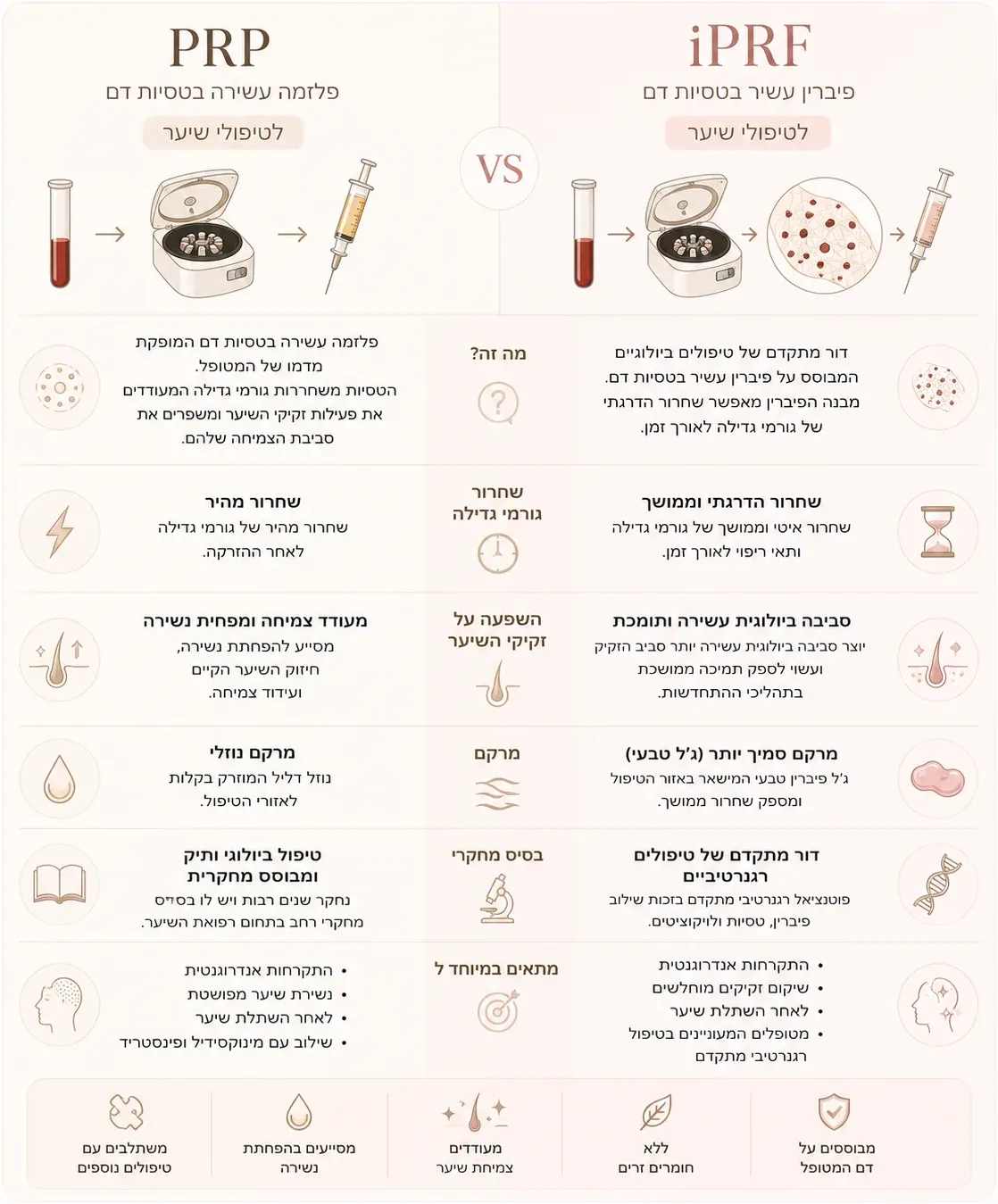
Both treatments are based on components from the patient’s own blood, but they differ in preparation and composition. With PRP, a high concentration of platelets and growth factors is obtained and released relatively quickly. With iPRF, a natural fibrin network is also obtained, allowing more gradual, sustained release of growth factors and ongoing support for scalp renewal.
- Treatment duration
- About 30–60 minutes
- Discomfort level
- When results appear
- Reduced shedding may appear within a few weeks, while improvements in density and hair quality develop gradually over 3–6 months.
- Number of treatments
- Usually a series of 3–4 treatments is recommended, depending on scalp condition and type of hair loss.
- Duration of effect
- Varies according to the cause of hair loss, treatment plan, and maintenance care.
Questions & answers
How does iPRF work?
When iPRF is injected into the scalp, growth factors are released gradually and support follicle activity and the growth environment.
The natural fibrin network allows sustained release of active components, providing ongoing support for scalp renewal.
The treatment may help by:
- Stimulating hair follicle activity
- Extending the active growth phase of the hair (Anagen)
- Improving blood supply to follicles
- Encouraging new blood vessel formation (angiogenesis)
- Reducing inflammatory processes around follicles
- Improving scalp quality
The goal is to create an optimal growth environment for hair follicles as part of a comprehensive plan tailored to the cause of hair loss.
Who is the treatment suitable for?
The treatment may suit a range of hair loss and thinning conditions, including:
- Androgenetic alopecia in men
- Androgenetic alopecia in women
- Diffuse hair thinning
- Reduced hair density
- Fine, weak hair
- Postpartum hair loss
- Telogen effluvium (when appropriate)
- Adjunct care after hair transplantation
- Combination with Minoxidil, Finasteride, and dutasteride
Suitability is determined after medical assessment, according to the type of hair loss, scalp condition, and follicle status.
How is the treatment performed?
Treatment begins with a simple blood draw. After centrifuge processing, iPRF is produced and injected into thinning areas of the scalp with fine injections.
The procedure usually takes 30–60 minutes. In most cases a series of treatments is recommended, followed by maintenance sessions as needed.
Is iPRF better than PRP?
iPRF and PRP are both based on the patient’s own blood, but they differ in how the product is prepared and in its composition. Thanks to the natural fibrin network, iPRF allows more gradual, sustained release of growth factors, and in many cases is an advanced option for treating hair loss.
The choice between treatments is made according to the patient’s condition and treatment goals.
Is iPRF suitable for all types of hair loss?
No. Effectiveness depends on the cause of hair loss, follicle condition, and disease stage.
Before treatment begins, a comprehensive medical assessment is performed, including history, clinical examination, and sometimes laboratory tests, to tailor an individual treatment plan.
Is iPRF a standalone treatment?
iPRF is an important tool in hair medicine, but in most cases it is part of a comprehensive plan. Depending on the cause of hair loss, the plan may also include medication, supplements, additional regenerative treatments, or addressing risk factors, to treat the underlying cause and achieve optimal long-term results.
When can results be seen?
Some patients notice reduced shedding within the first weeks. Improvements in density, hair thickness, and quality develop gradually over several months, according to the natural hair growth cycle.
Is one treatment enough?
Usually not. iPRF is a biological treatment that works gradually, so a series of 3–4 treatments at intervals of several weeks is often recommended, followed by maintenance as needed.
Can it be combined with other treatments?
Yes. iPRF can be combined with Minoxidil, Finasteride, dutasteride, mesotherapy, laser treatments, exosomes, hair transplantation, and other options.
In many cases, combining several methods addresses multiple mechanisms of hair loss at once and improves outcomes. The combination is decided after medical assessment according to the cause of hair loss.
What are the possible side effects?
Because the treatment is based on the patient’s own blood, the risk of allergic reaction or rejection is very low.
After treatment, local, temporary effects may occur, such as:
- Redness at the injection area
- Scalp sensitivity
- Mild swelling
- Small bruises at injection points
- Mild discomfort the day after treatment
In most cases you can return to routine the same day. As with any medical treatment, rarer risks and side effects also exist. Before each treatment, a medical consultation is held to assess suitability and fully explain benefits, risks, and possible side effects as part of informed consent.
In summary
iPRF is an advanced biological treatment based on natural components from the patient’s blood. Through sustained release of growth factors, it may help reduce shedding, improve hair quality, and increase density.
Thanks to its safety profile and ability to integrate with other treatments, it is one of the advanced options in hair medicine.