

Hair
Scalp botulinum toxin
Scalp botulinum toxin treatment
Scalp botulinum toxin is an innovative adjunct in hair medicine, studied in recent years as an additional option in androgenetic alopecia.
Unlike Minoxidil, Finasteride, and dutasteride, which act directly on alopecia mechanisms, botulinum toxin mainly affects the follicle environment. The hypothesis is that relaxing scalp muscles reduces mechanical pressure on tissues, improves microvascular blood flow and oxygen delivery to follicles, and thereby creates better conditions for activity.
Recent studies, systematic reviews, and meta-analyses reported improvements in density, hair diameter, and growth measures in some patients, with a good safety profile. Today it is considered a promising adjunct, especially combined with evidence-based treatments such as Minoxidil, Finasteride, or dutasteride.
Book a consultation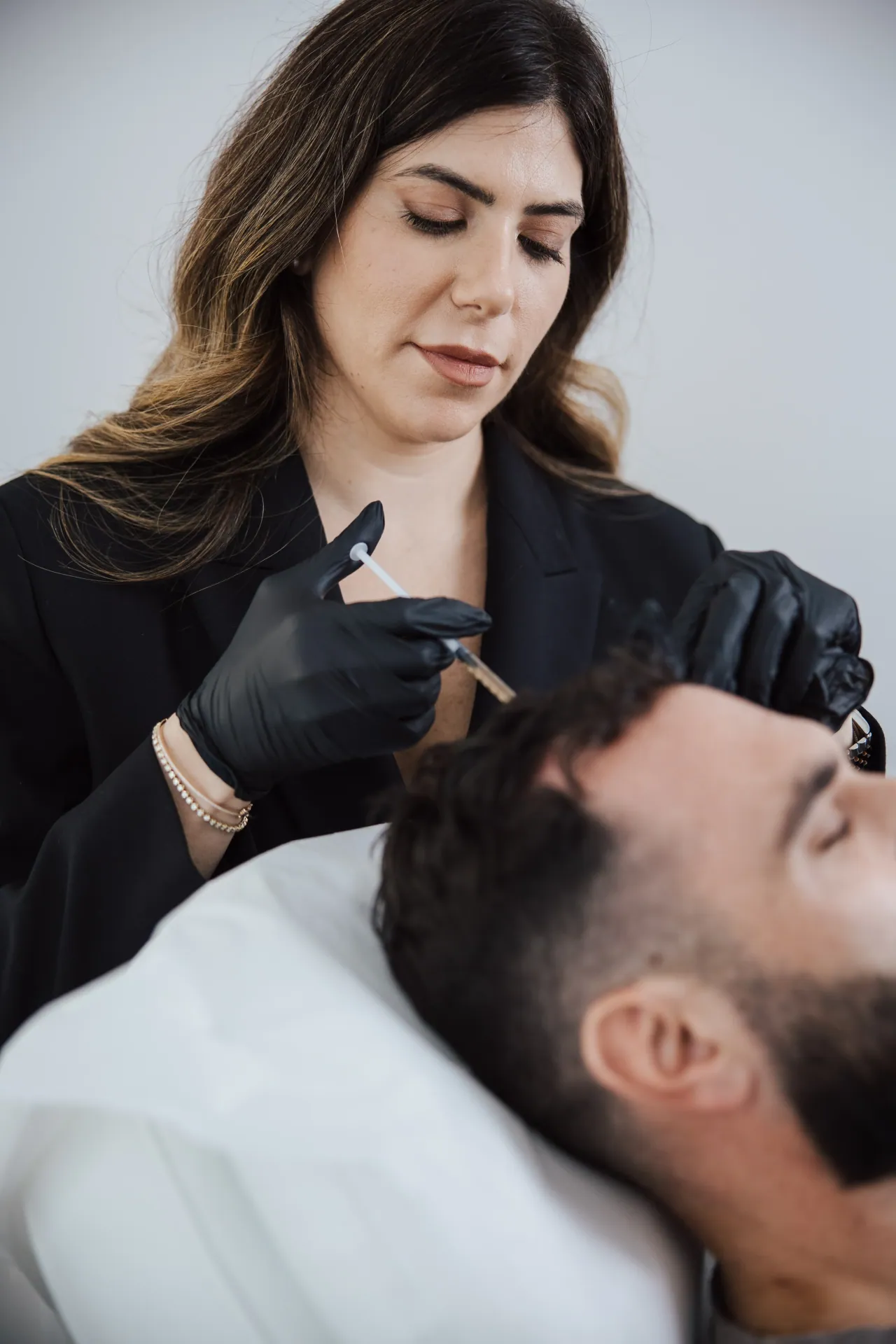
What is scalp botulinum toxin treatment?
Treatment is based on injection of botulinum toxin at defined points in scalp muscles.
A common theory is that in androgenetic alopecia there is chronic tension in scalp muscles, which may reduce blood flow and oxygen to follicular areas. Relaxing muscles with botulinum toxin may reduce this tension, improve local oxygenation, and create better conditions for follicle activity.
Laboratory studies also suggest botulinum toxin may reduce expression of inflammatory factors and TGF-β1 involved in follicle miniaturization. These mechanisms are still under research but offer a possible biological explanation.
Treatment benefits
- Innovative adjunct in hair medicine
- May improve hair density in some patients
- Improved microvascular scalp blood flow
- Relaxation of scalp muscles and reduced local tension
- May support hair follicle activity
- Short treatment with minimal downtime
- Can be combined with medical and regenerative treatments
- Treatment duration
- 15–30 minutes
- Discomfort level
- When results appear
- Usually after 3–6 months as part of a comprehensive plan.
- Number of treatments
- One treatment every 3–6 months according to clinical progress.
- Duration of effect
- About 3–6 months
Questions & answers
How does the treatment work?
The mechanism in alopecia is still being studied, but several possible biological pathways exist.
The treatment may help by:
- Relaxing scalp muscles and reducing local mechanical tension
- Improving microvascular blood flow and oxygen to follicles
- Improving the follicle activity environment
- Reducing inflammatory processes around follicles
- Reducing TGF-β1 expression involved in miniaturization
- Supporting other treatments such as Minoxidil and Finasteride
Meta-analyses and systematic reviews in recent years found possible increases in density and hair diameter, especially after about 6 months. One meta-analysis showed an average increase of about 24 hairs per cm²; some studies reported about 13%–20% density improvement. Studies combining botulinum toxin with Minoxidil and Finasteride showed greater density improvement than medication alone, supporting use as an adjunct in a comprehensive plan.
Who is the treatment suitable for?
The treatment may suit patients with:
- Androgenetic alopecia in men
- Androgenetic alopecia in women
- Thinning as part of alopecia progression
- Desire to add treatment within a comprehensive plan
- Increased scalp muscle tension or feeling of tightness
Suitability is determined after medical assessment according to type and severity of alopecia and treatment goals.
How is the treatment performed?
Treatment is performed with a series of fine injections at defined points in scalp muscles.
The procedure usually takes 15–30 minutes, requires little recovery time, and in most cases you can return to routine immediately.
When needed, treatment can be repeated every 3–6 months as part of ongoing care.
When can results be seen?
Improvement is not immediate.
Effect is usually assessed after about 3 months; most studies evaluated results after about 6 months. When appropriate, improvement may appear as increased density, thickness, and slower progression.
Can botulinum toxin replace Minoxidil or Finasteride?
No. Today it is not considered first-line for androgenetic alopecia, but an adjunct.
Better results are often achieved when combined with evidence-based treatments such as Minoxidil, Finasteride, dutasteride, or other regenerative options.
Can it be combined with other treatments?
Yes. It can be combined with Minoxidil, Finasteride, dutasteride, PRP, iPRF, scalp mesotherapy, Microneedling, and compounded preparations.
Combination addresses multiple mechanisms of alopecia; the plan is personalized.
What are the possible side effects?
Treatment is considered safe when performed by an experienced physician.
Common side effects are mild and temporary and may include:
- Pain or sensitivity at injection sites
- Local redness
- Mild swelling
- Small bruises
- Temporary headache
Rarely, temporary weakness of muscles near the injection area may occur. Full medical assessment is performed beforehand, with explanation of benefits, limits, and possible side effects.
Is botulinum toxin a standalone treatment?
In most cases scalp botulinum toxin is part of a comprehensive androgenetic alopecia plan. According to assessment, it can combine with medication, regenerative treatments, and compounded preparations to address multiple mechanisms for optimal long-term results.
In summary
Scalp botulinum toxin is an innovative adjunct that may improve the follicle environment through muscle relaxation and improved blood flow.
It fits into a broader plan alongside evidence-based treatments for hair loss and androgenetic alopecia.